
Catch 22: From Objects and Actions to Nouns and Verbs
Posted by Hannah Sawyer, Perrine Brusini and Julian Pine, University of Liverpool and Colin Bannard, University of Manchester
Have you ever heard someone say, “The postman bit the dog” or “The plumber delivered the parcel”? Probably not. And yet, you are instantly able to understand both sentences. This is because human languages are productive. In other words, we can come up with new sentences that other people can understand by putting a limited number of words together in an unlimited number of different ways.
As adults, we can do this because we don’t need prior exposure to every possible combination of words to be able to produce these combinations. Instead, we rely on the rules of English. These rules don’t tell us how to combine specific words like “dog”, “bit”, “postman”, or “deliver” — they tell us how to combine categories of words like Nouns and Verbs. So, as long as we know that “postman” is a Noun like “dog”, we can use “postman” in all the same places that we can use “dog”. And as long as we know that “delivered” is a Verb like “bit”, we can use “delivered” in all the same places that we can use “bit”.
But what about young children?
If you’ve ever had a conversation with a two-year-old, you will probably have noticed that young children’s language is productive too. Toddlers often say things they’ve never heard before, like “Look, two sheeps!” or “Santa bringed me lots of presents.” And if we teach them new, made-up words like “wug” and “blick” in sentences such as “This is a wug” and “This can blick”, they will happily take these words and slot them into sentences like “Give me the wug” or “Make it blick” — which suggests that they know that “wug” is a Noun and “blick” is a Verb, just like adults.
In short, categories like Noun and Verb are the building blocks of human languages — and children seem able to use these categories from very early in development. But how do they learn them? That is the question that we hope to answer in the new research project that we have just started.
A difficult question to answer
Explaining how children learn categories like Noun and Verb is actually more difficult than you might think. The basic problem is that, contrary to what you may have been taught at school, what makes a Noun a Noun, and a Verb a Verb is not what the word means, but how it fits into the rest of the sentence. For example, in the question “Shall we walk to the shops?”, “walk” is a Verb because — like other verbs — it comes after “we” and before “to”. But in the question “Shall we go for a walk?”, “walk” is a Noun because — like other nouns — it comes after “a” and before the end of the sentence.
Identifying Nouns and Verbs in terms of how they fit into sentences is easy if you can already speak the language, but what if, like a baby, you can’t speak the language yet? You seem to be in a Catch-22 situation. To learn how Nouns and Verbs fit into sentences, babies need to be able to find Nouns and Verbs in their caregiver’s speech; but to find Nouns and Verbs in their caregiver’s speech, they need to know how Nouns and Verbs fit into sentences.
So, what’s the solution?
The idea behind our project is that babies start out by dividing the first words they learn into words that refer to objects – like ‘spoon’ – and words that refer to actions – like ‘eat’. Babies then learn about the words that come before or after these object and action words and use them to decide whether new words fit into sentences in the same way. For example, a baby might initially decide that “spoon” is an object word and “eat” is an action word. Then, they’ll notice that “spoon” often comes after “a” and before the end of a sentence (as in “That’s a spoon”), and that “eat” often comes after “you” and before “it” (as in “Did you eat it?”).
When the baby hears a new word, they will use these patterns rather than the meaning of the word to decide what kind of word it is. For example, if they hear the word “walk” in the sentence “Shall we go for a walk?”, they will treat “walk” as an object word like “spoon” since it appears after “a” and before the end of the sentence. Over time, their object-word category will start to look more like a Noun category. In the same way, if they hear the word “want” in the sentence “Do you want it?”, they will treat “want” as an action word like “eat” and their action-word category will start to look more like a Verb category.
How can we test this idea?
In our project, we plan to test this idea in two ways.
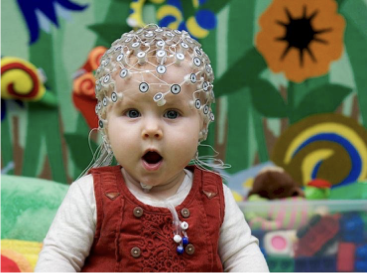
First, we want to see whether 10-month-olds can tell the difference between the handful of object and action words that they know at this age. Since 10-month-olds obviously can’t tell us whether they have spotted the difference directly, we will use a technique called EEG to measure their brain activity instead. We will play them lists of words like ‘dog, spoon, milk, ball and eat’ and see if their brains react to the difference between the first four object words (dog, spoon, milk and ball) and the final action word (eat). If they do, this will tell us that babies can tell the difference between object and action words, and we’ll know that the first part of our solution is along the right lines.
Second, we will teach 12-month-olds made-up nouns and verbs like “wug” and “blick” in sentences like “It’s a wug” and “It can blick.” Then, we will test whether they are surprised to hear these made-up words in sentences where they don’t fit, like “Make it wug” or “There’s the blick.” We will do this by recording babies’ pupil dilation responses in an eye-tracking experiment as this is a good way of measuring how surprised babies are. If 12-month-olds are surprised when they hear the made-up words in sentences where they don’t fit, this will tell us they have not just learned the made-up words but also paid attention to the kind of sentences in which they originally heard them – supporting the second part of our solution.
Of course, it’s very early days, and there’s still a lot of work to do before we know the answers to either of our questions. At the moment, we’re just putting the finishing touches to our experiments in the hope that we will be able to start testing babies soon. But if, like us, you’re interested in knowing how babies build categories like Noun and Verb, watch this space!