
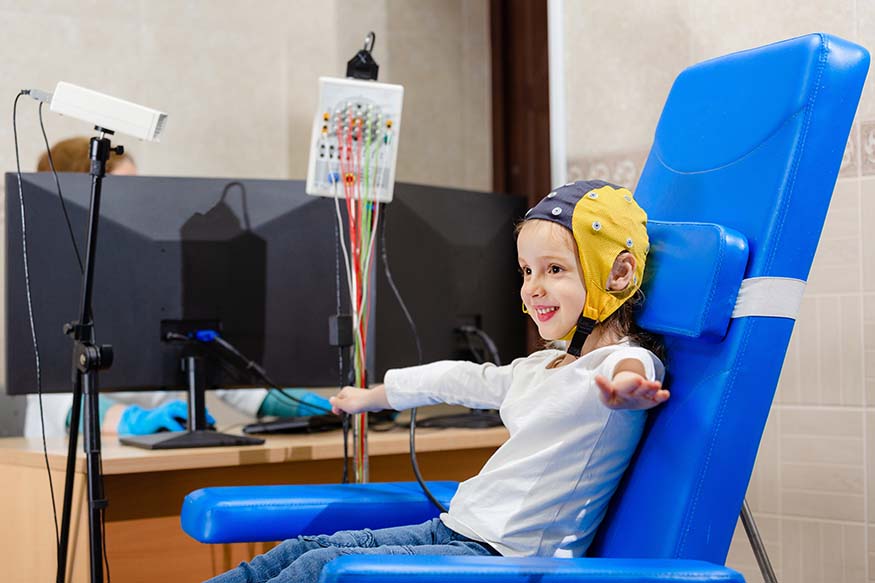
Understanding the neural processes involved in word learning in typically developing children and children with DLD
This project aimed to understand how the brain processes continuous speech in order to identify words—a process known as speech segmentation—and how it may differ in individuals with Developmental Language Disorder (DLD) and related conditions. To do this we created 6 sets of artificial language streams featuring syllabic-distribution cues, syllabic-stress cues and their combination (distribution combined with stress and distribution pitted against stress) as well as two control conditions: random syllable and random stress. Using a combination of EEG and behavioural measures, we investigated the temporal dynamics and individual variability of speech segmentation in typical and atypical adults.
Project Team
Perrine Brusini (Lead), Colin Bannard, Alissa Ferry, Larry Leonard, Panagiotis Boutris, Grégoire Vergotte
Duration
1 July 2020 – 31 October 2025
Project Number
1.2
Progress and Key Achievements
Over the final reporting period, the project achieved full data collection and completed the core analyses of both EEG and behavioural datasets.
Participants and Data Collection:
- Adults: 62 adults were tested, of whom 43 were retained for the final EEG dataset after quality control.
- Atypical Adults: 24 participants with language-related difficulties were tested (diagnosed with dyslexia, DLD, or ADHD); 20 were included in the final dataset (11 with dyslexia, 9 with DLD/ADHD).
EEG Results:
- Spectral Analyses: Transforming the EEG signal into the frequency domain, we replicated classical results from Buiatti et al. (2009), revealing clear peaks at the word-frequency level across all structured conditions, and at the syllable-frequency level in all conditions except resting-state.
- Time-Frequency Analyses: Preliminary time–frequency transformations are being used to identify when and where participants segment speech, allowing us to trace the phase consistency of neural activity associated with successful segmentation.
- Group Differences: Atypical participants showed higher overall neural power. Adults with dyslexia exhibited noisier low-frequency activity, suggesting less stable auditory tracking, whereas adults with DLD/ADHD showed reduced sensitivity to stress cues, indicating possible difficulties in processing rhythmic or prosodic features of speech.
Behavioural Results:
- Behavioural results featured expected outcomes: distributional-cues stream, stress-cues stream and the combination of both cues were successfully segmented by participants while the condition that pitted stress against distributional-cues did not significantly pass the 50% chance threshold.
- Across the 6 artificial-language learning paradigms, participants showed high individual variability in segmentation performance.
- Using k-means clustering (based on gap-statistic), we identified two behavioural profiles—“high” vs. “low” segmenters—and are now linking these clusters to neural markers derived from the EEG data.
- This approach provides a unified view of how behavioural success in speech segmentation corresponds to underlying neural mechanisms.
Outputs and Dissemination
- 3 manuscripts are in preparation:
- Neural Markers of Speech Segmentation in Adults: Linking Temporal and Spectral Signatures to Behavioural Success (target: Brain and Language; early 2026)
- Language Disability Modulates Neural Sensitivity to Prosodic and Statistical Cues to Segmentation (target: Journal of Cognitive Neuroscience; spring 2026)
- Classifying Typical and Atypical Language Processing from EEG: Towards an Automatic Neural Screening Tool (target: Cerebral Cortex, end 2026)
- Preliminary findings were presented at the Society for the Neurobiology of Language (Brisbane, SNL 2024) and we plan to present our final analysis at the Cognitive Science Society (Rio de Janeiro, CogSci 2026) conferences.
- Pre-processing and analysis scripts are being finalised for open-access release on the OSF platform, ensuring transparency and re-usability.
Impact and Legacy
This project provides a robust framework for linking individual differences in neural dynamics to behavioural variability in language processing, and, subsequently, language learning. The replication of classic segmentation effects and the new evidence from atypical populations extend current models of speech processing and developmental language disorders.
The methodological and theoretical groundwork established here directly informs the PI’s newly awarded ESRC-funded project on early syntactic acquisition (2025–2028), ensuring continuity and long-term impact within the UK developmental neuroscience research.
Next Steps Beyond the Project End Date
- Completion of the time–frequency and connectivity analyses on both typical and atypical adult datasets.
- Submission of 3 manuscripts and dissemination of findings through OSF and the Liverpool Language Lab network.
- Continued translation of findings for practitioners (e.g., speech and language therapists) through knowledge exchange events.
Contact Us
+44 (0) 161 306 6000


0 Comments