
It has long been claimed that the child’s experience of language is not sufficient to enable them to learn language, and so language structure must be innate and internal to the child. However, this traditional view depends on considering the child’s experience of...
Category: Research project
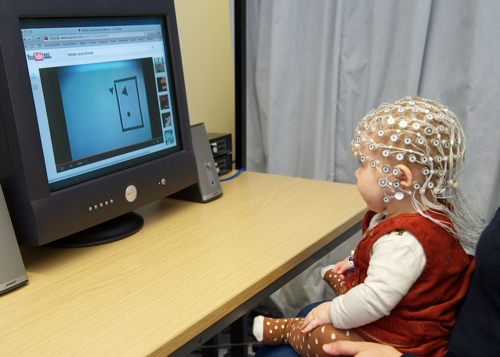
How social cognition and communication link to language development during and infancy
We investigated how early social cognition in infants, such as communication with adults and sensitivity to particular communicative signals, can drive specific aspects of language acquisition.We used a variety of methods including electroencephalogram (EEG). EEG...
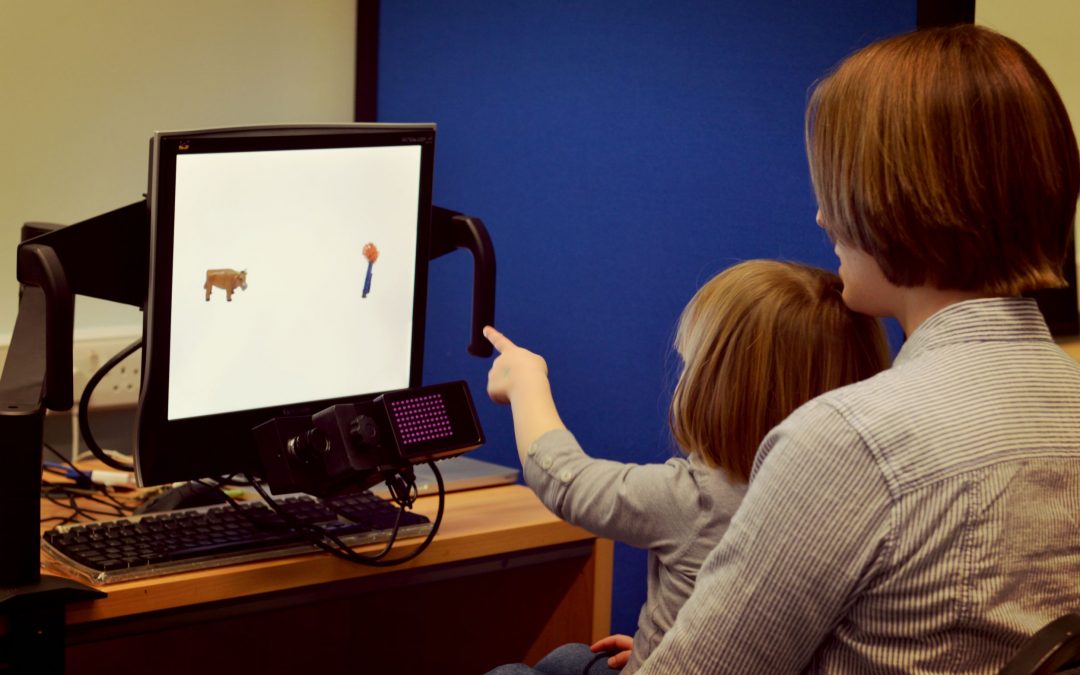
Integrating visual and semantic cues with language learning
This work package focused on how children use semantic cues such as animacy, causality and intentionality to develop linguistic concepts and knowledge.1. Infants’ visual preferences and their relation to later language learningAlthough we know quite a lot about...
Vision and Language
Language is used to convey meaning, but how does it come to have meaning? One source for understanding meaning comes from visual information.To learn the meaning of “the girl chased the boy”, we need to see events where girls chase boys. Critically in this sentence,...

Investigating prelinguistic development in three minority cultures
Humans are unique in their desire and motivation to share experiences and draw attention to objects and events ‘for sharing’s sake’. Indeed there is a strong theoretical argument that what is unique to human evolution and to the development of language is the...

Learning basic morphosyntax in languages with case marking: Polish, Finnish and Estonian
Many languages mark nouns with inflections that reflect the role of the noun in the sentence (its ‘case’). In English, only pronouns show case-marking (e.g. he, him, his to mark nominative, accusative and possessive, respectively). But children learning other...

From lexical to abstract knowledge: The case of wh-questions
The aim of this project was to investigate the balance between lexically-specific and abstract syntactic knowledge, and, in particular, how the latter develops from the former. In order to do so, we focussed on the well-studied and relatively circumscribed domain of...

Distributional learning and the development of word class categories in English, German and Dutch
How do children learn the grammatical categories of their language? For example, how do children learn that dog is a Noun and chase is a Verb? Recent research with computer models of language learning has shown that one way of doing this is to group words together on...

Learning how to inflect verbs in different languages
This project considered how children learn to inflect verbs to convey different meanings such as person (1st vs 2nd: in English, "I" vs. "you"), number (singular vs. plural: in English, "is" vs. "are") and tense (present vs. past: in English, "is" vs. "was"). English...

The transition from preverbal to language-based cognition
The development of object knowledge and word learning are critical early components of the broader language acquisition task, and understanding the processes by which infants construct their first linguistic representations is vital to our understanding of language...
Contact Us
+44 (0) 161 306 6000


Recent Comments