

What have chess grandmasters taught us about the way children learn their first language?
By Andrew Jessop, Fernand Gobet, and Julian Pine
By studying how novice chess players become elite grandmasters, psychologists have learned a lot about how we become experts.
Chess grandmasters can rapidly recognise patterns on a chess board and accurately recall complex configurations after seeing them for only a few seconds, whereas novice players are slower and can remember the position of fewer pieces.
For example, the chess24 YouTube channel tested Magnus Carlsen, the highest rated chess player in history, on his ability to recognise specific games based on the arrangement of the pieces. After only a few seconds of analysing the board, Carlsen could name the players, the competition, and even the moves that followed.
Cognitive researchers have studied how advanced players develop these skills as they become more experienced. They discovered that grandmasters could recognise meaningful patterns on the board by grouping together the individual pieces into chunks. Rather than trying to memorise the position of each individual piece, they quickly spotted familiar chunks comprised of multiple pieces, as shown in the image below:
-
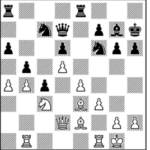
- Novice players often try to recall the individual pieces.
-
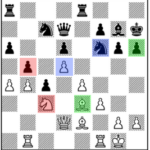
- Advanced players recognise meaningful chunks.
But what does this have to do with how children develop language skills?
In the same way as chess players develop into grandmasters, children begin as novices and slowly learn to master their native language through experience, and studies suggest that chunking may be at the heart of both abilities.
There are interesting parallels between language development and chess expertise. Just as chess players become faster at recognising meaningful patterns on a board as they become more knowledgeable, researchers have found that children become faster at recognising words (i.e., meaningful patterns of sounds) as their vocabulary grows and they become experienced with their language.
Children with larger vocabularies can also recall and produce fake non-words (e.g., versatrationist) more accurately, in the same way that grandmasters can recall novel chess boards more accurately than less skilled players. This is because they can draw on their language knowledge to find familiar chunks hidden within these unfamiliar stimuli.
As part of our research in LuCiD, we examined whether infants learn their first words by chunking together the sounds they hear in their parent’s speech. To do this, we created a new computer model called CIPAL (Chunk-based Incremental Processing And Learning), which learns chunks for different patterns that appear in children’s language input.
CIPAL was heavily inspired by an earlier computer model called CHREST (Chunk Hierarchy and REtrieval STructures), which was designed to study how grandmasters, like Magnus Carlsen, rely on chunking to recognise meaningful patterns on a chess board. But instead of clustering together chess pieces, the CIPAL model groups speech sounds into syllables, words, and multiword chunks.
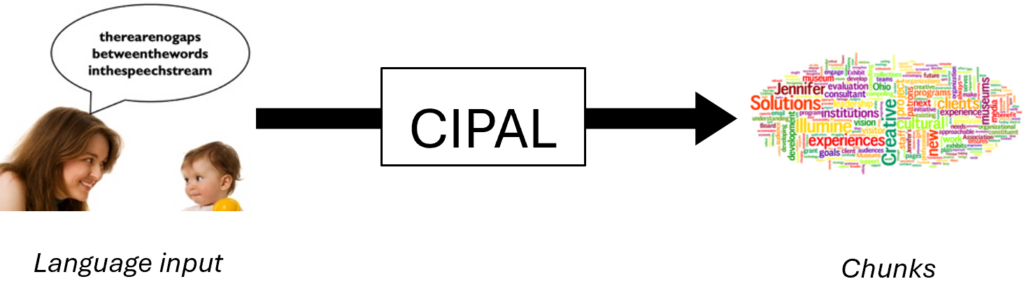
For example, imagine you are listening to a stream of syllables in a language you have never heard before: bidakutupirogolabubidakupadoti.
It would be difficult to recall this stream of syllables after only a few seconds. But this task would become much easier if you could segment the input into a smaller number of chunks. In essence, this is how CIPAL learns patterns in different languages. The model creates chunks, such as bidaku, by grouping syllables that appear together in the input. When it encounters this sequence again, it is now much easier to process: bidaku tupirogolabu bidaku padoti. This is because the model uses the familiar chunk bidaku to segment the speech stream into a small number of distinct units, similar to the way we split the sentences we hear into individual words.
Across multiple studies, we found that the chunking mechanisms in CIPAL could discover words in more than a dozen natural languages, simulate the results of experiments that use made-up languages to examine word learning in infants and adults, and model the developmental increase in the speed with which children recognise familiar words. But this is just the beginning. We are optimistic that CIPAL will provide insights into other aspects of children’s language learning in the future.
Other work by LuCiD researchers has found chunking can also explain how children learn grammatical rules. It is common for children learning English to make errors such as “Daddy go” instead of saying “Daddy goes”. Studies with MOSAIC (Model of Syntax Acquisition in Children), another computer model inspired by chess expertise research, suggests that such mistakes are due to the way in which children form their early chunks. In particular, children appear to pay more attention to the end of the sentences they hear; they learn chunks such as “Daddy go” from questions such as “Where did Daddy go?”, which occur frequently in child-directed speech.
Our understanding of children’s language learning has benefited from bringing together ideas from diverse fields of psychology. It is unlikely that the pioneers studying chess grandmasters could have predicted that their work would help to unlock the mysteries of word learning or grammatical development. We can only imagine where future discoveries may come from.
Contact Us
+44 (0) 161 306 6000


0 Comments