

Testing pragmatic accounts of complex linguistic constraints
The aim of this project was to investigate the proposal that children’s acquisition of complex linguistic constraints can be satisfactorily explained only in terms of their developing social, cognitive, and pragmatic knowledge and abilities (and not, as has often been...

Modelling the cross-linguistic pattern of verb-marking deficits in children with Developmental Language Disorder
In this Work Package we developed a new cross-linguistic model of the pattern of verb-marking error in typically developing children and children with Developmental Language Disorder (DLD). Children with DLD show different patterns of error depending on the language...

Understanding the neural processes involved in word learning in typically developing children and children with DLD
This project aimed to understand how the brain processes continuous speech in order to identify words—a process known as speech segmentation—and how it may differ in individuals with Developmental Language Disorder (DLD) and related conditions. To do this we created 6...

Using computational modelling to understand developmental language disorder (DLD)
In this work package we addressed the underlying causes of developmental language disorder (DLD). While much is known about the specific difficulties faced by children with DLD, we do not know how these problems arise. Computational modelling is a way to develop...

When to Lean on LENA Measures?
Posted by Dr Jill LanyIf you've ever wondered how much the language a baby hears affects how they learn to talk, you're not alone. This topic has been of central interest to language development researchers for well over 50 years. In the past decade, there’s been a...

YouTube feature on how babies learn to speak
LuCiD's Julian Pine (University of Liverpool) was recently interviewed by the RobWords YouTube channel in an episode exploring how babies acquire language. He shared insights from his work on the early stages of language development. The image shown above is courtesy...

New research shows why toddlers still beat AI at learning language
LuCiD Centre study reveals how toddlers master language faster than advanced artificial intelligence systemsYoung children learn language with remarkable efficiency that far surpasses even the most sophisticated artificial intelligence systems, according to new...
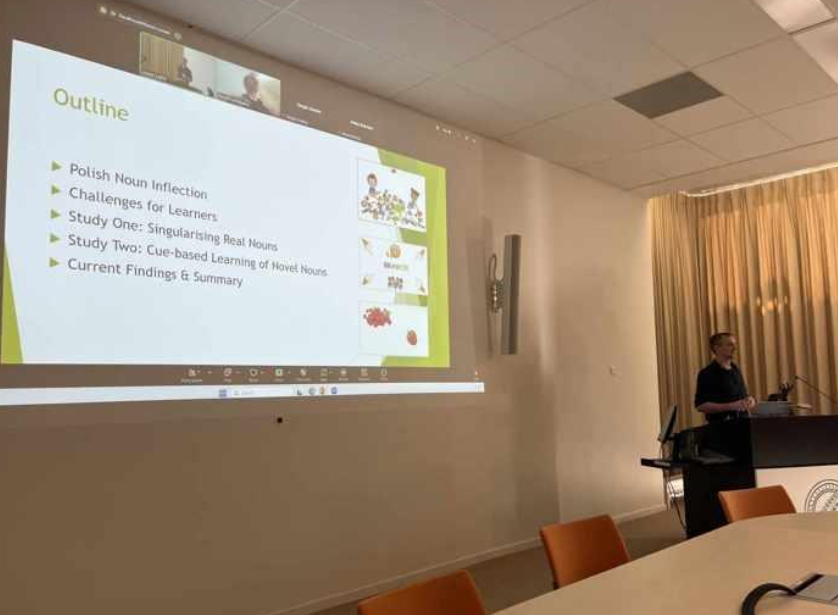
LuCiD travel grant experience: a week at MPI Nijmegen exploring language processing
Posted by David Price-WilliamsIn an unseasonably sunny April 2025, I had the pleasure of spending a week at the Max Planck Institute for Psycholinguistics (MPI) at Nijmegen in the Netherlands, thanks to a kind LuCiD Travel Award.MPI Nijmegen is home to a multinational...

Travelling responsibly : reflections on sustainable travel as a researcher
In this blog, Thea Cameron-Faulkner shares her reflections on sustainable academic travel, drawing on a recent LuCiD-related visit to Madrid. From supporting early career researchers to making conscious travel choices, she begins her story on the penultimate leg of a...

LuCiD Postdoc Dr Samantha Durrant works with BBC Tiny Happy People on baby milestones article
Dr Samantha Durrant, a post-doctoral research associate at LuCiD, has recently collaborated with BBC Tiny Happy People on two articles designed to help parents and caregivers support early childhood development.The most recent article, Understanding baby milestones: A...
Contact Us
+44 (0) 161 306 6000


Recent Comments