
Babbling babies like to talk
Posted by Gert Westermann, Lancaster University
9-month-old Elise is sitting contentedly on her playmat, banging her toy on the floor, and babbling to herself, “gagaga”. Like most children, she has been making sounds since she was only a few months old: squeals and grunts at first, but later becoming more and more like speech. But what is this babbling for?
One reason why babies babble is clear: they are practicing using their vocal apparatus. This helps their brain to make a link between the motor commands for positioning their tongue, jaws and thorax in a specific way while blowing out air (because this is how we make speech sounds) and the sounds they make as a result. In fact, we know from brain studies with adults that when adults hear a sound, the areas in their brain used for making these sounds become active, almost as if they are producing the sound themselves.
But just producing random sounds to practice making them is not all there is to babbling – in fact, the sounds babies make in their babble gradually come to be like the sounds of their native language. Exactly when this shift from general to language-specific babbling happens is controversial because it’s hard to measure and the differences can be quite subtle. But clearly at some point around one year of age, babies produce sounds from their own language more than those from other languages, so what they hear influences the sounds they make. In this way, babbling prepares babies for speaking their first words – and indeed, we know that the first words a baby says are linked to the sounds they have been able to produce in babbling (some sounds, like ‘k’, are harder to produce than others, like ‘b’ and ‘m’, so ‘baba’ and ‘mama’ are easy to say).
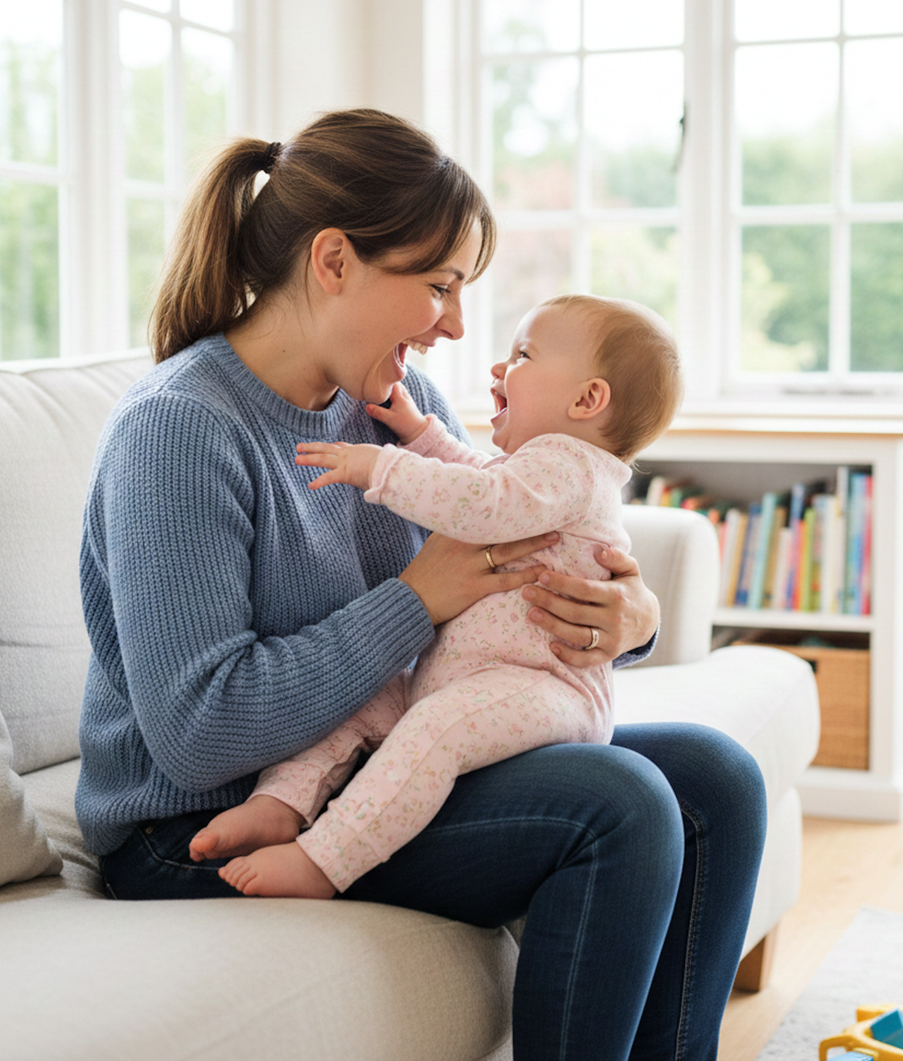
So you might think that babbling is just to help babies learn to say words. But it turns out there’s even more going on than that. Babies use babbling to get the attention of the people around them and ‘talk’ to them! In one study, babies played with their parents while babbling away – but at one point during this play, parents were asked to adopt a ‘still face’ – not responding to the baby anymore and keeping a fixed facial expression. This can be disconcerting for a baby, and the experimenters observed that as a consequence, babies increased the rate of their babbling, using it to re-engage the parent.
Parents seem to be tuned into what their babies are doing and often take turns, responding to their baby’s babble either by imitating it, or by guessing what the baby might have meant to say and responding (“”Gaga.” “Yes, it’s a kittycat, look, it’s all black!”). While there is nothing wrong with imitating baby sounds, some research has found that babies benefit more from parents responding with real language because it helps them learn words and figure out how language works.
So if you join Elise on her play mat and hear her babbling, don’t always just respond with ‘gagaga’ yourself, but talk to her about her toys and about anything else you like, taking turns to communicate with your preverbal baby!
Contact Us
+44 (0) 161 306 6000


0 Comments