

Parents’ views of their autistic children’s language use
Blog by Kate M. I. Scarborough, Dr Kathy Leadbitter & Dr Katherine E. Twomey (University of Manchester)"We never thought it was meaningless; getting to the meaning is the challenge"Sometimes autistic children repeat sentences that they have heard from television...

What have chess grandmasters taught us about the way children learn their first language?
By Andrew Jessop, Fernand Gobet, and Julian PineBy studying how novice chess players become elite grandmasters, psychologists have learned a lot about how we become experts.Chess grandmasters can rapidly recognise patterns on a chess board and accurately recall...

Toddler talk: Parents are helping us map UK language learning
By Katie Alcock, Lancaster UniversityHow do children differ from each other? Why does one child say their first words at 8 months old, but another one might not manage to say anything until 10 months later? How different is children’s early vocabulary in different...

Outputs 2026
Zhang S, Ferry A, Brandt S, Warren E, Theakston A. 2026. Iconicity does not always facilitate complex sentence comprehension: Behavioral and pupillometric evidence from Mandarin–English bilingual adults. Applied Psycholinguistics, 47:e44.Bazhydai, M., M. K. Y....
Do Fish Have Barcodes? Why children’s questions hold the key to unlocking the mysteries of language acquisition
Posted by Ben Ambridge “Do fish have barcodes?” My 3-year-old had just paid his first visit to Pets-At-Home, and clearly had some questions. If you’ve spent any time around children – whether your own or other people’s – you’ll be all too aware of their knack of...

Catch 22: From Objects and Actions to Nouns and Verbs
Catch 22: From Objects and Actions to Nouns and Verbs Posted by Hannah Sawyer, Perrine Brusini and Julian Pine, University of Liverpool and Colin Bannard, University of Manchester Have you ever heard someone say, “The postman bit the dog” or “The plumber delivered the...

Babbling babies like to talk
Posted by Gert Westermann, Lancaster University 9-month-old Elise is sitting contentedly on her playmat, banging her toy on the floor, and babbling to herself, “gagaga”. Like most children, she has been making sounds since she was only a few months old: squeals and...

Bridging the Gap: Team approach to engaging with practitioners about research and its practical application
Posted by Dr Samantha Durrant and Carly Hartshorn Sharing research findings with practitioners can present a challenge for researchers — after all, the leap from academic findings to real-world application is not always straightforward, obvious or clear (even to the...
Cues for different language learning tasks: Simultaneous or successive learning?
It has long been claimed that the child’s experience of language is not sufficient to enable them to learn language, and so language structure must be innate and internal to the child. However, this traditional view depends on considering the child’s experience of...
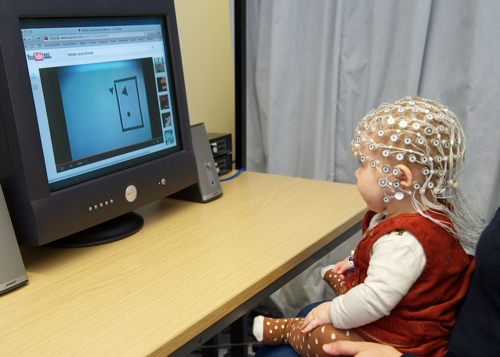
How social cognition and communication link to language development during and infancy
We investigated how early social cognition in infants, such as communication with adults and sensitivity to particular communicative signals, can drive specific aspects of language acquisition.We used a variety of methods including electroencephalogram (EEG). EEG...
Contact Us
+44 (0) 161 306 6000


Recent Comments